

The Department of Construction is the graduating department for the bachelor's degree program in Construction. As part of the training of professional construction personnel, the department provides the educational process in accordance with the curricula of the disciplines, the department's work plan, and the individual work plans of the faculty members.
Methodological support of disciplines
All disciplines have been developed and updated annually, including curricula, syllabi (workbooks), lecture materials, and guidelines for practical classes and laboratory work. There are also guidelines for course projects (works), methodological developments for independent study and self-study, рубежного контроля, and other materials for assessing students' academic knowledge, including final exam test questions.The developed scientific and methodological documentation is available to students in electronic form in the educational materials of the network environment disciplines. Modern teaching technologies are used in the educational process: multimedia lectures and practical classes, presentations, discussions, and electronic publications. Modern software products are also used: the software package for calculating and designing building structures PC LIRA; Compass 3D V19, and the 3D Printer Anet ET4. The department's teachers introduce innovative forms and methods of teaching into the educational process, and they widely use active forms of teaching, such as problem lectures, interactive teaching methods using information presentations, and ongoing and final testing of students. The department has established a laboratory for "Construction Materials." Work has been carried out to create a pilot-scale laboratory for the production of construction materials (wall hollow stone, paving slabs, etc.).
Visiting each other's classes and conducting open classes
Open classes and mutual visits by teaching staff within the department are held in order to improve the educational process, enhance the teaching skills of teaching staff, and exchange best teaching practices, as well as to introduce new educational methods and forms of work, innovative technologies, and identify students who are interested in studying certain subjects in greater depth.
Open classes and mutual visits by teaching staff are conducted in accordance with the approved schedule and analysis of the class.
Conducting scientific and methodological seminars at the department
One of the forms of organizing the educational process is the holding of scientific and methodological seminars at the department. Methodological materials for reports and presentations are prepared for these seminars. The main purpose of scientific and methodological seminars is to familiarize participants with current trends in the construction industry, engineering achievements, and innovative technologies, as well as to discuss the prepared materials in the form of new scientific and methodological developments in the field of educational technologies and their transformation into the educational process.
Methodological support of students' independent work
The department's teaching staff develops the following: guidelines with assignments and examples for students' independent work in all disciplines of the "Construction" educational program; topics for essays and reports; instructions and guidelines for laboratory work and training exercises; topics for coursework and diploma projects; lists of required and additional literature. There are two types of independent work for students: Independent work under the direct supervision of a teacher and according to their assignments, and independent work carried out by a student according to the teacher's assignment, but without their direct participation. The organization of independent work is aimed at stimulating students' motivation for educational and scientific activities, independent work, self-education, and self-improvement.
The department has a full set of mandatory educational and methodological documentation, including working programs for disciplines, methodological guidelines for practical and laboratory classes, recommendations for students' independent work (SRSP and SRS), materials for intermediate assessment, such as exam questions and milestone controls (RK1 and RK2), and current knowledge assessment materials, including assignments, control questions, and tests.
For students' independent work, the department has prepared additional electronic publications on disciplines that are important for study, as well as reference and information materials, materials from scientific and practical conferences, collections of articles, and scientific journals.
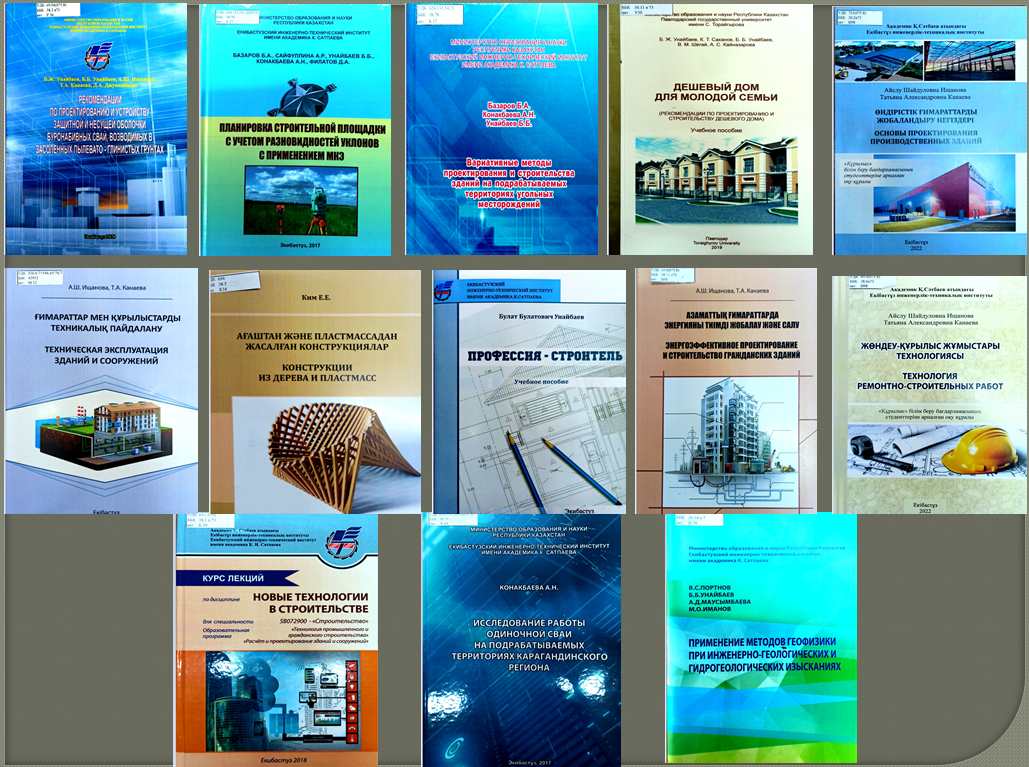
Textbooks by the Department's Faculty
1. Cheap house for a young family: Recommendations for the design and construction of a cheap house: a textbook/B. N.J.Unaibayev, K. N.T. Sakanov, B. N. B. N. Unaibayev, V. N.M. N. Shegai, A. N. According to S. N. Kainazarov. - Pavlodar:Toraighyrovuniversity, 2019. 158 p.
2. Unaibayev B. N.J. Modern buildings and structures: An educational and methodological guide/ B. N.J. Unaibayev, A. N.S. Ishchanova, V. N.N. Doktorov, V. N.A. Arsenin-Ekibastuz: YITI named after academician K. N. Satpayev, 2019. 96 p.
3. Kanaeva T. N.A. New technologies in construction: Textbook / T.N.A. Kanaeva. Ekibastuz: EITI named after academician K. N. Satpayev, 2018-132 p.
4.Unaibayev B. N.J. B. Unaibayev.B. N. Piles in saline soils of Kazakhstan: A monograph./ B. N.J. Unaibayev, B. N. B. N. Unaibayev. Almaty: Evero, 2018. 376 p.
5. Unaibayev B. N.J. V. Arsenin.A. B. Unaibayev.B. N. D. Sivaraksha.M. N. Innovations in the development of territories with folded saline soils in the Republic of Kazakhstan: Monograph/Unaibayev B. N.J. V. Arsenin.A. B. Unaibayev.B. N. D. Sivaraksha.M. N. - Almaty: Evero, 2018. - 224 p.
6.Унайбаев Б.Б. Технология строительного производства. Часть 1. Учебное пособие. Екибастуз: ЕИТИ им. К.И. Сатпаева. 2015. - 96 с.
7. Азаматтық ғимараттарды энергиялық тиімді жобалау және салу. Энергоэффективное проектирование и строительство гражданских зданий: Оқу құралы / Ищанова а.ш., Канаева Т. А. – Екібастұз: академик Қ. Сәтпаев атындағы ЕИТИ, 2021. – 137 с.
8. Ағаштан және пластмассадан жасалған конструкциялар / Structures made of wood and plastics/ Kim E. E.- Екібастұз: Академик Қ. Сәтпаев атындағы ЕИТИ, 2021. – 121 с.
9. Қазақстанның аймақтық топырақ жағдайларында жобалау және құрылыс (тұзды топырақтар) / Design and construction in the regional soil conditions of Kazakhstan (saline soils): оқу құралы / Унайбаев Б.Ж., Унайбаев Б.Б., Ищанова А.Ш. – Екібастұз: академик Қ.Сәтпаев атындағы ЕИТИ, 2021. – 176 с.
10.Ғимараттар мен құрылыстарды техникалық пайдалану/ Technical operation of buildings and structures / Ishanova A.Sh., Kanaeva T.A.– Екібастұз: Академик Қ. Сәтпаев атындағы ЕИТИ, 2022. – 170 с.
11. Өндірістік ғимараттарды жобаландыру негіздері/ Fundamentals of Industrial Building Design/ Ishanova A.Sh., Kanaeva T.A.– Екібастұз: Академик Қ. Сәтпаев атындағы ЕИТИ, 2022. – 198 с.
12. Жөндеу-құрылыс жұмыстары технологиясы/ Technology of Repair and Construction Works/ Ishanova A.Sh., Kanaeva T.A.– Екібастұз: Академик Қ. Сәтпаев атындағы ЕИТИ, 2022. – 198 с.
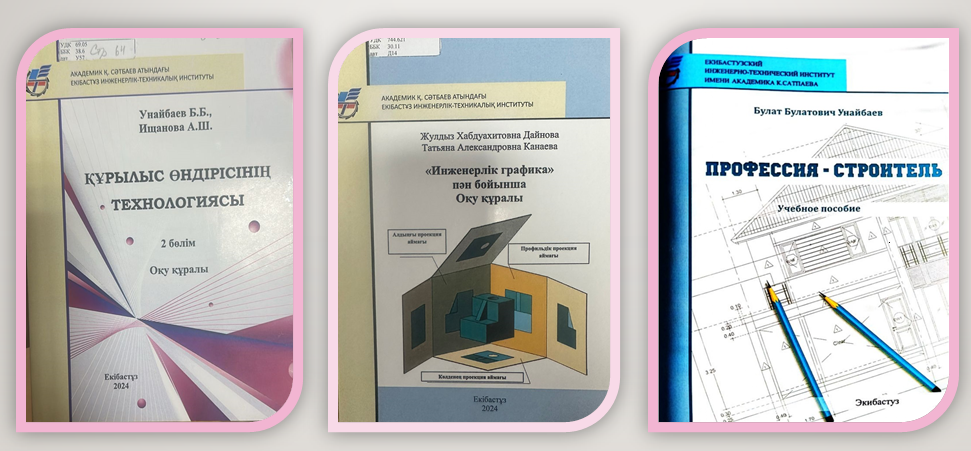
13.Unaibayev B. B. Profession – builder: a textbook /B. B. Unaibayev. Ekibastuz: YITI named after academician K. Satpayeva, 2024. 55 P..
14. Dainova zh.Kh., Kanaeva T. A. in the discipline engineering graphics. Textbook /Dainova zh.Kh., Kanaeva T. A.-Ekibastuz: EITI named after academician K. Satpayev, 2024. – 117 P.
15.Унайбаев Б.Б., Ищанова А.Ш. Құрылыс өндірісінің технологиясы: Оқу құралы/ Унайбаев Б.Б., Ищанова А.Ш. Екібастұз: Академик Қ. Сәтпаев атындағы ЕИТИ, 2024.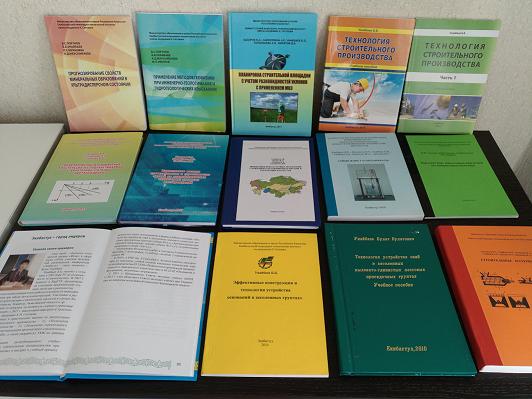
Methodological support of production practices
The Department implements the Modular Educational Program "Construction" in collaboration with leading city-forming organizations: GIDROPROM LLP, Vershina LLP, and BERT LLP.
To provide practical training for students, the Department has developed the basic principles of end-to-end practice, which ensure a unified and comprehensive approach to the organization of practical training, as well as the systematic and continuous learning of students.
The general provisions and requirements for the organization of end-to-end practice for students of the 6B073 – Architecture and Construction program contain the main goals and objectives, as well as the methodology for organizing practice, taking into account the specifics of the Educational Program, the features of practice bases, and the provision of necessary conditions for conducting practice.
Educational and Laboratory Base of the Department of Construction
Includes:
- Laboratory of Building Materials.
Here, students study building materials and structures. They perform laboratory and practical work in the discipline of Building Materials and other disciplines of the Educational Program.
Laboratory classes are aimed at developing students' professional skills, mastering the characteristics of modern building materials, and acquiring the ability to use them in real-life practical situations.
Every year, new tools and equipment are acquired to improve the laboratory facilities, which enhances the quality of the educational and scientific process, as well as the practical training of students and expands their scientific opportunities.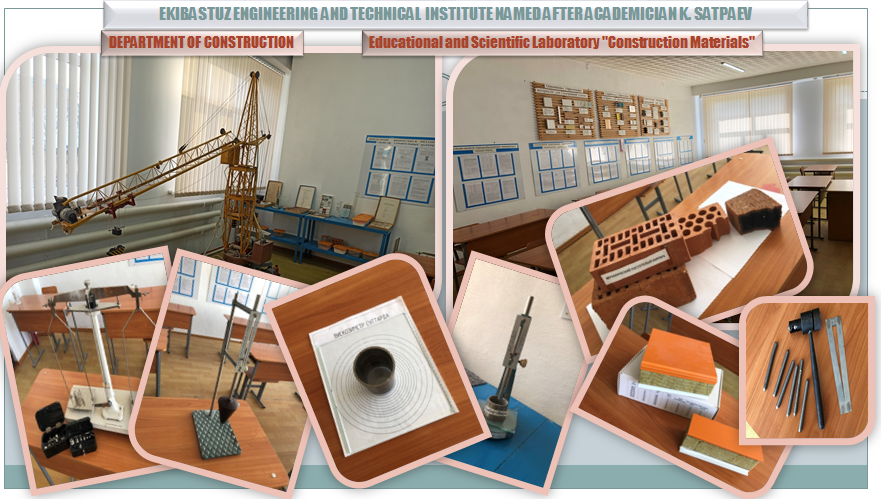
- Studio classes (model workshop)
- conducting studio classes and classes on model modeling for students in the field of study 6V073 – Architecture and Construction; conducting lectures and practical classes on the disciplines of the Department of Construction; conducting SRSP and consultations on the disciplines of the Department and consultations on diploma design.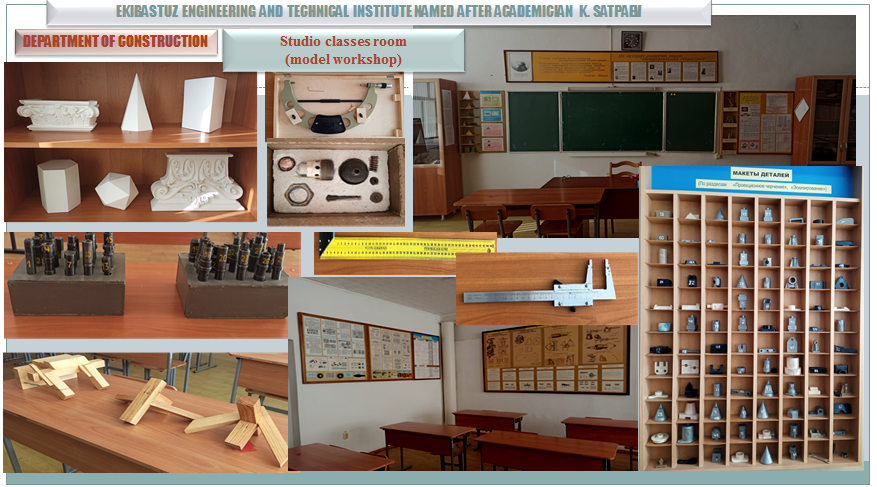
- Cabinet of Building materials and construction Physics
Conducting lectures and practical classes in the following disciplines: Building Materials, Construction Technology, Geotechnics, Foundations and Constructions: Modeling, Calculation, and Design, Fundamentals of Designing Industrial Buildings, Construction Technology, and others.
- An auditorium with multimedia equipment (a computer, a projector, sound speakers, and an interactive whiteboard) (auditorium C-107). In this auditorium, students can observe various technological processes, from the production of building materials and structures to the construction of buildings.